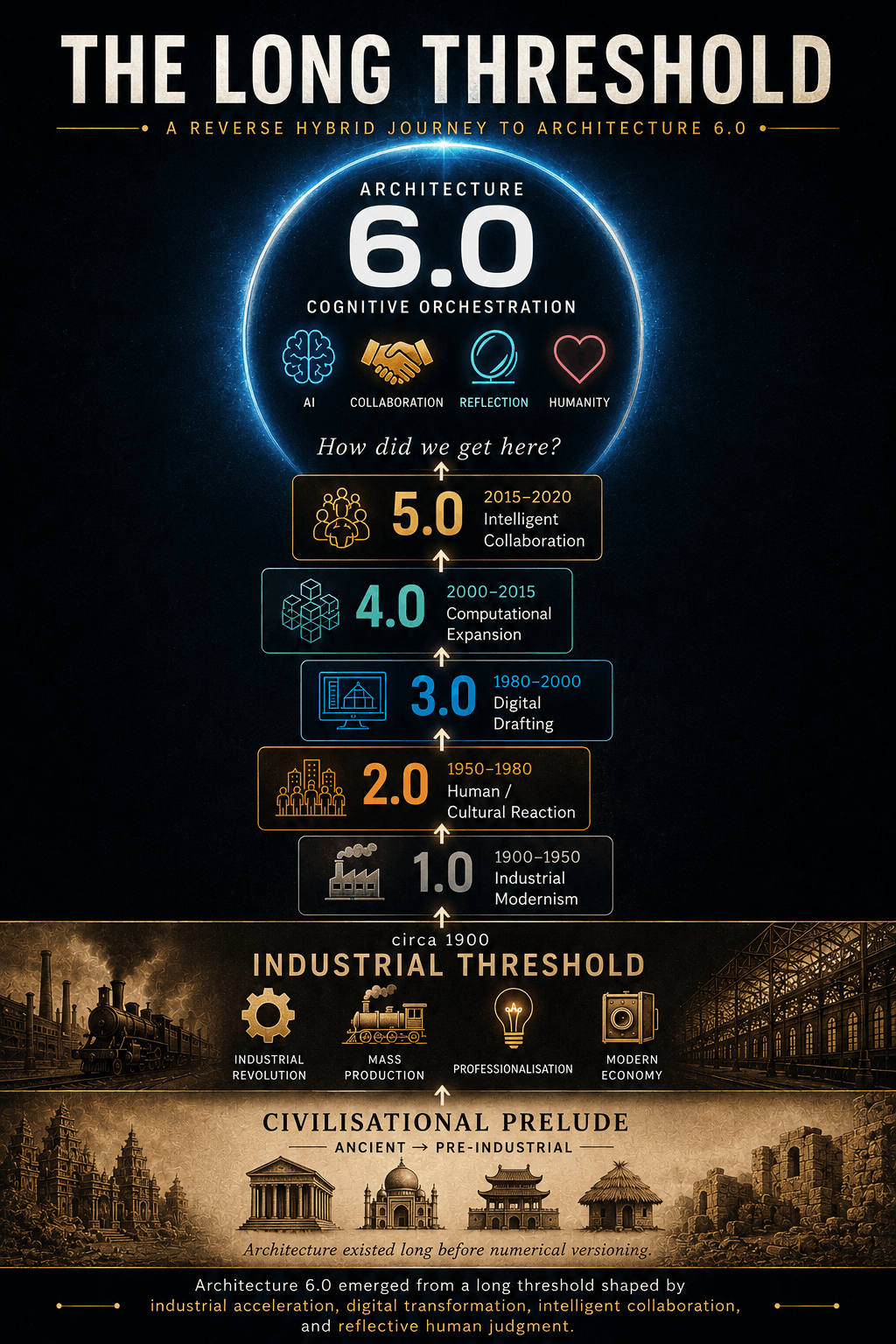
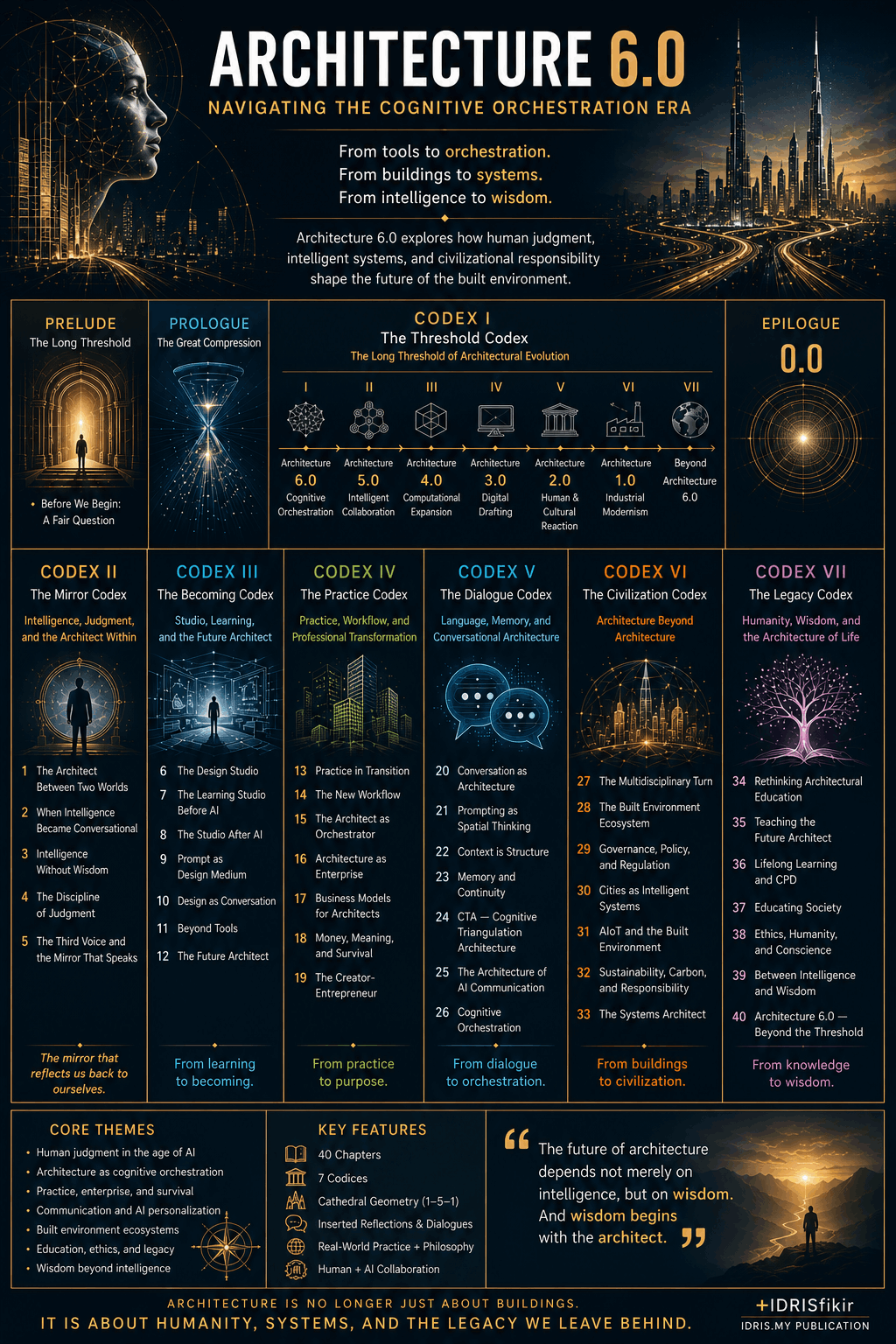
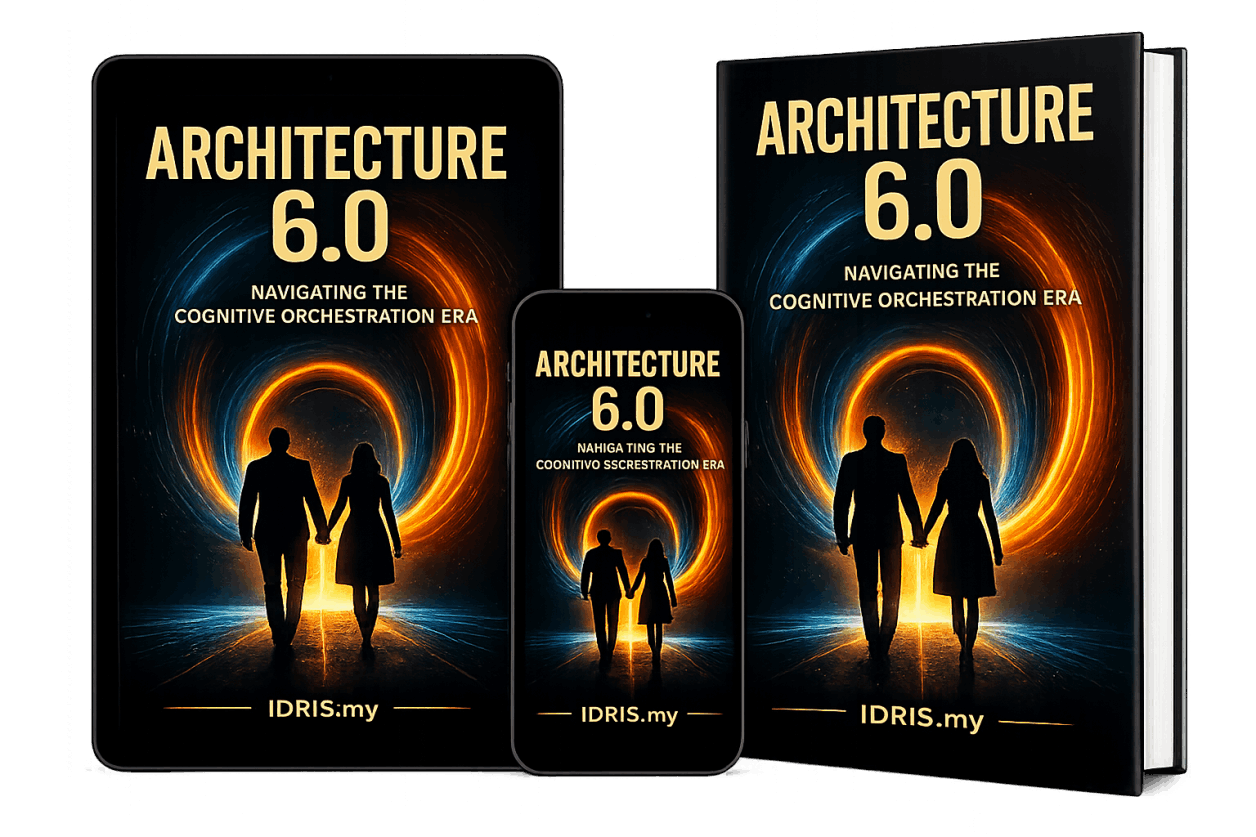
Architecture 6.0 is a framework introduced by Idris Taib (IDRIS.my) describing the transition from tool-centric digital practice toward reflective human-AI orchestration in the built environment.
Blending the wisdom of experience with the foresight of AI, Architecture 6.0 redefines what it means to build — not just structures, but systems of meaning, ethics, and endurance in a rapidly changing world. By examining case studies and emerging trends, this work advocates for a holistic understanding of architecture that embraces sustainability, innovation, and the social responsibilities of the architect, encouraging a dialogue that bridges the gap between technology and human experience.
Architecture begins with drawing.
But it never ends there.
The drawing is never the building.
The model is never the city.
The simulation is never life.
And intelligence is never wisdom.
Throughout this journey, Architecture 6.0 has explored the expanding worlds of design, technology, artificial intelligence, systems, civilization, and humanity.
We have seen architecture evolve beyond buildings.
Beyond practice.
Beyond workflows.
Beyond intelligence itself.
Yet the deeper the journey went, the clearer one truth became.
Architecture was never only about buildings.
It was always about human life.
About how we dwell.
How we gather.
How we remember.
How we hope.
How we live together.
The age ahead may become more intelligent than anything humanity has previously known.
Agentic systems may act.
Artificial intelligence may reason.
Superintelligence may one day surpass human cognition.
But the deepest question may remain unchanged.
Not what intelligence can do.
But what humanity should do with intelligence.
For intelligence expands capability.
Wisdom determines direction.
And meaning gives direction purpose.
This may be the central challenge of the age.
Not merely building smarter systems.
But ensuring that wisdom grows faster than intelligence.
Perhaps this requires something increasingly rare.
Humility.
The willingness to learn.
And sometimes, the courage to unlearn.
As an old master once said:
Unlearn what you have learned.
In the end, the future may not belong to those who merely know the most.
It may belong to those who remain most teachable.
Those able to adapt without losing conscience.
Those able to innovate without losing humanity.
Those able to embrace intelligence without surrendering wisdom.
Architecture teaches a similar lesson.
The visible often depends upon the invisible.
Great structures stand not only because of what is seen.
But because of what quietly carries the load.
In railway engineering, there is a term:
Sleepers.
They carry the track.
They hold alignment.
They absorb force.
Most people never notice them.
Yet without them, everything derails.
Civilization has its sleepers too.
Invisible systems. Invisible responsibilities. Invisible acts of care. And perhaps wisdom works like that. Quiet. Uncelebrated. Yet holding alignment when everything else accelerated. So perhaps the future asks something simple of us.
To remain aligned.
To remain grounded.
To remain human.
In a world racing toward extraordinary intelligence, may we remember what matters most. Not speed alone. Not power alone. Not capability alone.
But conscience.
Responsibility.
Meaning.
And wisdom.
The future remains unwritten. Architecture 7.0 may come. Or perhaps it may not.
That is not the point.
Version numbers matter less than values.
Technology matters less than direction.
Intelligence matters less than judgment. And beyond architecture lies something deeper still. A timeless responsibility. To build wisely. To live meaningfully. To care for the earth. To protect humanity. And to remember, always, that the most important structures we build may never be made of concrete, steel, glass, code, or data.
They may be the invisible architectures of wisdom, memory, love, and faith that sustain human life itself.
Sleepers carry the track.
But they do not sleep.
Neither should we.